In response to a question posed by Karen Wohlwend on my previous post, I have decided to draw out my thoughts here.
The question posed was whether writing is “just speech written down on paper.”
Writing is not just transcribing speech down on paper. Speech written really only exists in very specific, often academic, contexts (such as in linguistic research) and is often incomprehensible to readers, especially those who do not share the same context. When speaking, people use generalities to refer to things in time and space, drawing on immediate and personal contexts that are not contained in words, speak with extensive filler sounds, stutters, starts and restarts, and with what would be considered a wide-range ungrammaticalities. Writing, at least in its traditional sense, is a completely different animal with different rules and conventions which, in turn, sound stiff and clunky when spoken.
Further, I would say that writing extends beyond writing on paper as well. The obvious example to the point would be our blog posts and the use of "book-machines" like the Amazon's "Kindle." To extend further back in history, with the fear of being overly thorough, much writing has been done on a number of different materials from parchments to stones.
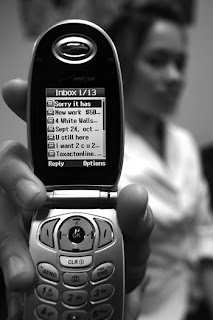
In addition and returning to our more immediate time, Mrs. Wohlwend has alluded to less formal writing on other devices, such as texting on cell phones. I find this to be an inviting thought. I have had frequent conversations with a high school teacher in Newark, NJ who has described her students, who are perennially behind in all their subject areas, as having the potential to text their papers faster than they could type them. I found this an intriguing idea (especially as I am a rather clumsy texter), and was even more drawn in when I gathered that, had she the means, she would actually consider allowing them to submit papers via text – even if only first drafts.
The benefit, naturally, would be drawing out the students already developed ability to communicate in written language. They are able to emote and explain complex ideas and life situations, often with the aide of T9 (which I use extensively). However, the drawback is that “text-talk” is deeply diverged from standard written English and is unintelligible to many readers – especially those who are not fluent in the language of the highly adaptable texting world. This is not to make a value judgment on this kind of writing, but rather to mention one of its weaknesses – inaccessibility. As a teacher, it seems reasonable and appropriate to meet students where they have texting skills and then help them to extend those to write standard American English (if you prefer). Texting certainly can provide some basic, though often technically complicated skills, but I believe these should be a baseline from which to further develop their writing.
I am interested in learning more about your thoughts concerning texting as a writing form and if you know of any resources which address this topic. Are there tools developed and in place to harvest and capitalize on the skills which these learners already have? Are there more benefits you see or reservations you have concerning texting? What are they and how can they be either be used for student benefit or adequately addressed?
Finally, what other forms of writing do you see that are accessible to the upcoming generation which we and former generations may be missing?
Picture URLs:
http://www.thecreativepenn.com/wp-content/uploads/2008/12/istock_writing.jpg